
Looking for a San Fernando Valley Realtor who actually grew up here? Clark Hill was born and raised in the Valley, and it is still home. With more than 20 years as a Broker Associate at Pinnacle Estate Properties, he has helped clients buy, sell and invest across the region.
What the Valley Actually Is
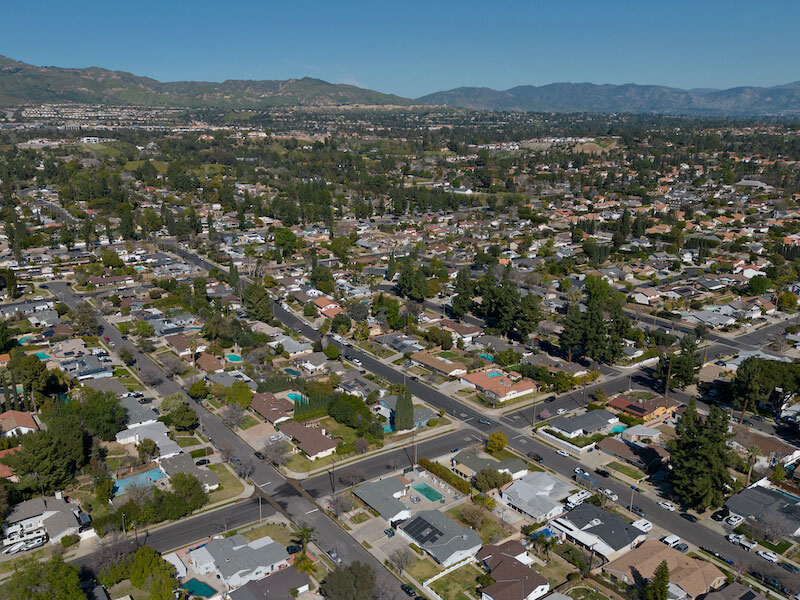
The San Fernando Valley stretches across roughly 260 square miles, framed by the Santa Susana, San Gabriel, and Santa Monica mountains.
The San Fernando Valley covers roughly 260 square miles, ringed by the San Gabriel Mountains to the northeast, the Verdugo Mountains to the east, the Santa Monica Mountains and Chalk Hills to the south, the Simi Hills to the west and the Santa Susana Mountains to the northwest. You reach the rest of Southern California through its passes — Newhall toward Santa Clarita, Sepulveda to the Westside, Cahuenga into Hollywood, Santa Susana out to Simi. As of 2023 about 1.8 million people live here, which would make the Valley one of the largest cities in the country if it were one.
It very nearly became one. In 2002, Measure F asked voters whether the Valley should secede from Los Angeles and incorporate on its own. It failed. But the fact that the question got that far says something real about how separate this place feels from the city it belongs to, and clients who have lived here a long time still talk about it.
How It Got Built
In 1909 the Suburban Homes Company bought 48,000 acres of Valley farmland and laid out the road grid and the first towns — Van Nuys, Reseda, Canoga Park. What turned that grid into a city was water: after Los Angeles secured aqueduct rights, federal rules barred selling surplus water outside city limits, so in 1915 the Valley annexed itself into Los Angeles to get on the municipal system. Dry wheat farming gave way to irrigated citrus, walnuts and apricots. Then came the war, and aerospace, and the studios: between 1945 and 1960 the Valley’s population quintupled. Most of the housing stock people buy and sell here today comes out of that postwar boom, and it behaves like it.
January 17, 1994
The Northridge earthquake was a 6.7 that produced the largest ground motions ever recorded in an urban environment. Fifty-seven people died, more than 1,500 were seriously injured, and roughly 12,500 structures took moderate to severe damage. Freeways buckled as far as 25 miles from the epicenter.
Three decades on, that morning still shows up in Valley transactions, and it is one of the practical reasons local experience matters here. Soft-story apartment buildings and older single-family homes have been through retrofit requirements and voluntary upgrades in the years since. Foundation bolting, cripple-wall bracing and permit history for post-1994 repair work are all things a buyer should be looking at and a seller should have answers for. So are the questions that follow — what earthquake coverage costs, what a lender will want, and what actually has to be disclosed. An agent who has worked the Valley through that period knows which questions to ask about a given house and which ones are noise.
One Valley, Many Markets
The Valley is dozens of neighborhoods, not one, ranging from dense stretches like Van Nuys and Panorama City to quieter foothill communities in the north and west. School boundaries, HOA rules, fire-zone disclosures and street-by-street pricing can all shift within a few blocks. Clark works most actively in four communities, each with its own character:
- Porter Ranch — a newer, master-planned community in the foothills with some of the highest household incomes in the Valley.
- Chatsworth — low-density and rural-feeling, anchored by Stoney Point Park and the Santa Susana Mountains.
- Northridge — a younger, more rental-heavy market built around California State University, Northridge.
- Granada Hills — a settled, family-oriented community with one of the highest homeownership rates in the northwest Valley.
A Lifelong Local, Not a Transplant Agent
Clark grew up in the San Fernando Valley, went to school here, and lives here today with his family. That is a different kind of knowledge than an agent who simply covers the area — he has watched these neighborhoods change across decades, through the earthquake, through several market cycles, and he brings that to every transaction.
Clark’s Valley Track Record
More than 20 years as a Realtor and broker across the San Fernando Valley, with experience spanning first-time buyers, move-up sellers, and complex probate and trust sales. Clark also owns investment property in the Valley and has years of experience as a landlord, which gives him a rental-market and long-term-value perspective that few agents can offer.
Why Valley Homeowners Choose Clark
Clark’s goal is 100% satisfaction from every client he works with, backed by a simple pledge: if you hire him and you’re not happy with his work, you can fire him — no hard feelings. Combined with lifelong local roots, that accountability is why so much of his business comes from repeat clients and referrals.
What Clients Say
- “Clark is the best realtor I’ve ever had and I will definitely use only his services from now on for all of my future properties. I definitely recommend Clark to all of my friends whoever wants to buy or sell a property.” — Ilya B. (Yelp review)
- “Clark is an outstanding real estate agent who walked me through the entire process. He was available anytime I had questions and made the entire process seamless. Best real estate experience ever!” — Linda A. (Yelp review)
Frequently Asked Questions
How much San Fernando Valley experience does Clark Hill have?
Clark has more than 20 years as a licensed Realtor and Broker Associate working across the San Fernando Valley, and was born and raised here.
Which Valley neighborhoods does Clark work in most?
Northridge, Porter Ranch, Granada Hills and Chatsworth, along with the wider Valley.
Does earthquake retrofitting still matter when buying in the Valley?
It can. Much of the Valley’s housing stock predates the 1994 Northridge earthquake, so foundation bolting, cripple-wall bracing and the permit history for any post-earthquake repair work are worth reviewing on an older home, along with what earthquake coverage would cost.
Does Clark Hill have investment property experience in the Valley?
Yes. Alongside his work as a Realtor and broker, Clark owns investment property in the San Fernando Valley and has years of experience as a landlord.
Is Clark Hill a licensed Realtor?
Yes. Clark Hill is a licensed Realtor and Broker Associate, California DRE #01461661.
Ready to Buy, Sell or Invest in the San Fernando Valley?
Whether you’re purchasing a first home, selling a longtime family property, or growing an investment portfolio, Clark Hill brings lifelong local roots and a straightforward satisfaction pledge to every client relationship. Contact Clark today to get started, or call (818) 384-1622.